In this guide
Why I Shot New York After Dark
Most of my Charleston work happens in daylight, golden hour at the latest. New York changed that. The city does not really show you its best angles until the sun goes down and the buildings start doing the lighting for you. I spent an evening in DUMBO and along the Brooklyn waterfront working almost entirely in blue hour and full dark, chasing the kind of light I rarely get to shoot back home.
No client, no shot list, just the bridges, the skyline, and whatever crowd happened to be out that night. New York rewards that kind of open-ended shoot better than almost anywhere else I have worked, because there is genuinely something worth photographing in every direction.
The Manhattan Bridge from DUMBO
Washington Street in DUMBO is one of the most photographed blocks in New York, and once you stand there you understand why immediately. The street lines up dead-center with the Manhattan Bridge, and on a clear evening the Empire State Building sits perfectly framed inside one of the bridge's stone arches. I shot it at dusk with the sky still holding a deep blue and the street lit by headlights and shopfronts on either side.
It is a genuinely hard shot to make your own, since thousands of photographers stand in that exact spot every week. What helped was patience: waiting for a car's headlights to streak through the frame, waiting for the crowd to thin for a few seconds, and shooting several frames rather than settling for the first clean one.
From underneath, the bridge reads completely differently. I shot straight up into the steel trestle work at dusk, letting the structure itself become the subject rather than any building or skyline behind it. That angle strips out the postcard version of the shot and replaces it with something more abstract: rivets, cross-bracing, and the raw scale of a 120-year-old suspension bridge from directly below.
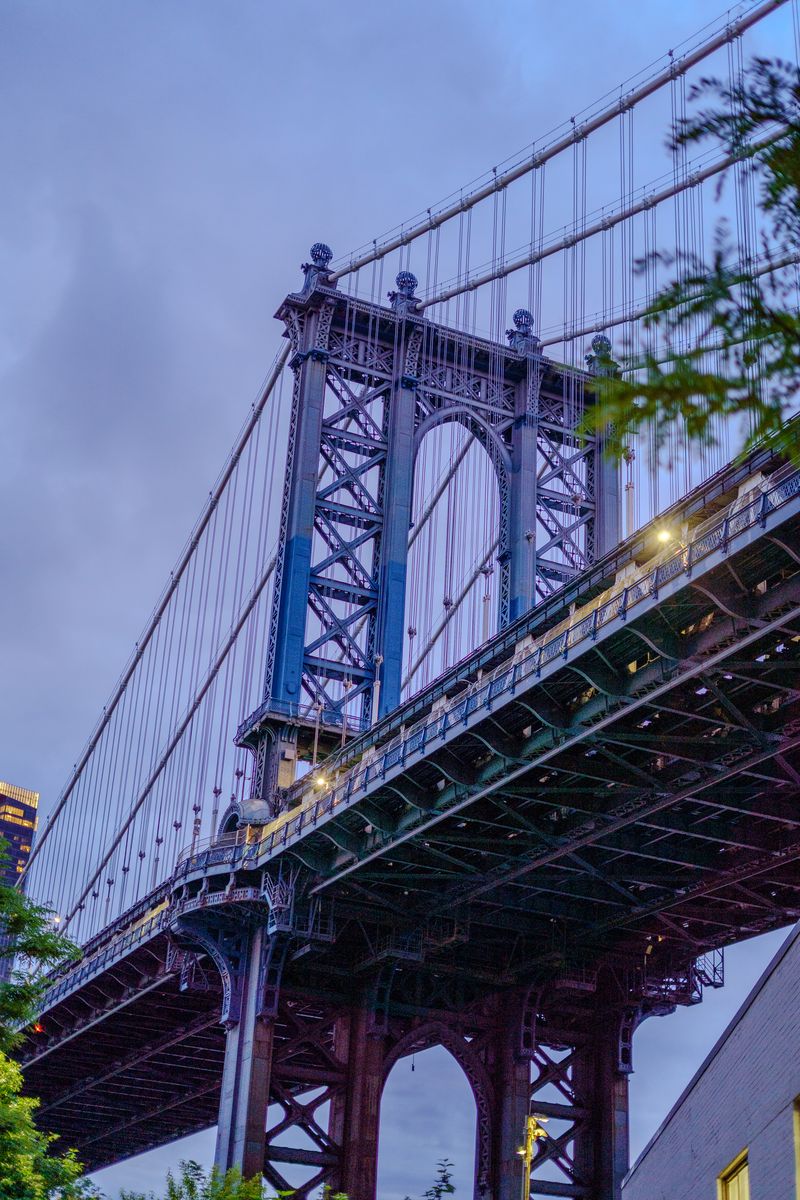
The same bridge can be a postcard or an abstraction depending entirely on where you stand.
The Brooklyn Bridge Skyline
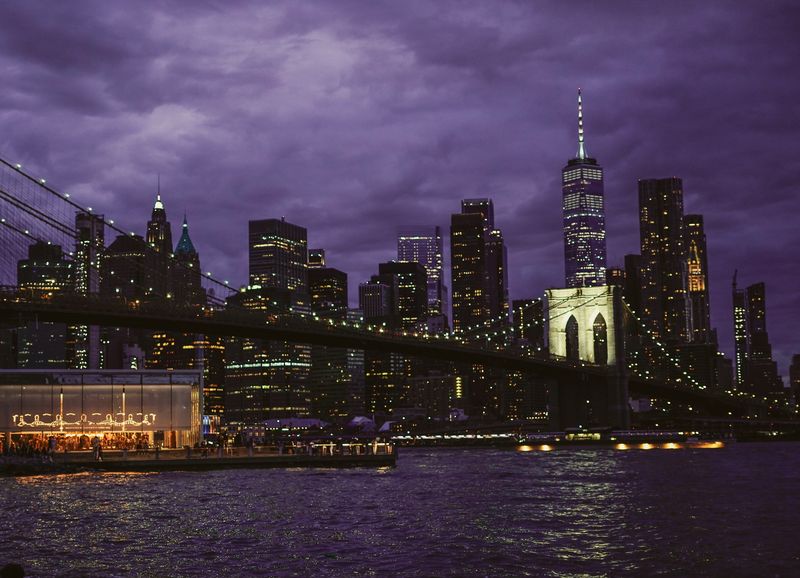
A short walk from DUMBO, Brooklyn Bridge Park gives you the wide version of the same story: both bridges, the full Lower Manhattan skyline, and the East River doing the reflecting for you. I shot this one from the park's edge once the sky had gone fully dark and the city lights had taken over completely, One World Trade Center's spire cutting the highest line into the frame.
Wide shots like this live or die on foreground interest. A completely empty river reads as generic. I waited for a small tour boat to cross into frame near the bottom third of the composition, giving the eye something to anchor on before it travels up into the skyline.
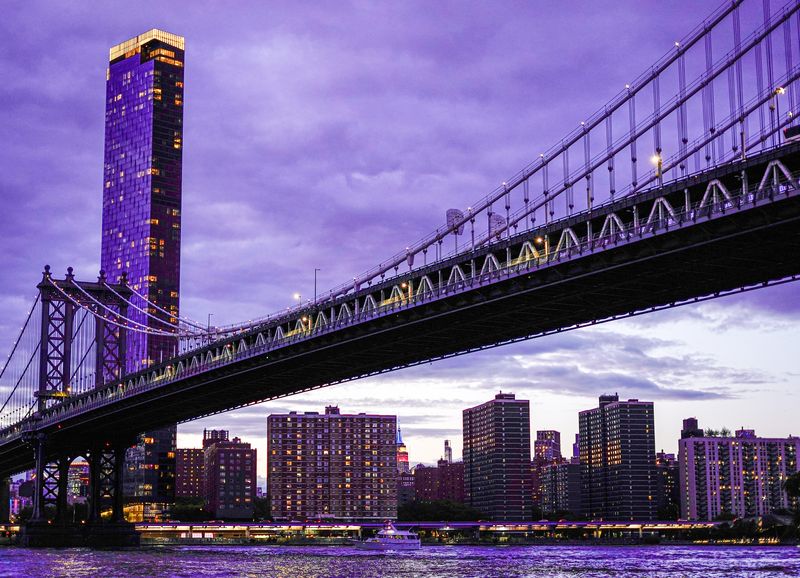
Pro Tip: Shoot Bridges from More Than One Angle
Every major bridge gives you at least three distinct photographs: the wide establishing shot with the skyline, the tight architectural detail from underneath, and the framed street-level shot looking straight through it. Shooting only one of the three leaves the other two on the table. Walk the full length of a location before you settle on your favorite frame, not just the first angle that looks good.
A Found Moment at Fleet Week
Not everything from the trip was a bridge. Walking through the theater district one night, I ran into a group of sailors in dress whites dancing in the middle of the sidewalk, pulling passersby into the moment. I did not plan for this shot and did not need to. Camera up, a few frames, and one of the most alive images from the whole trip was done in under ten seconds.
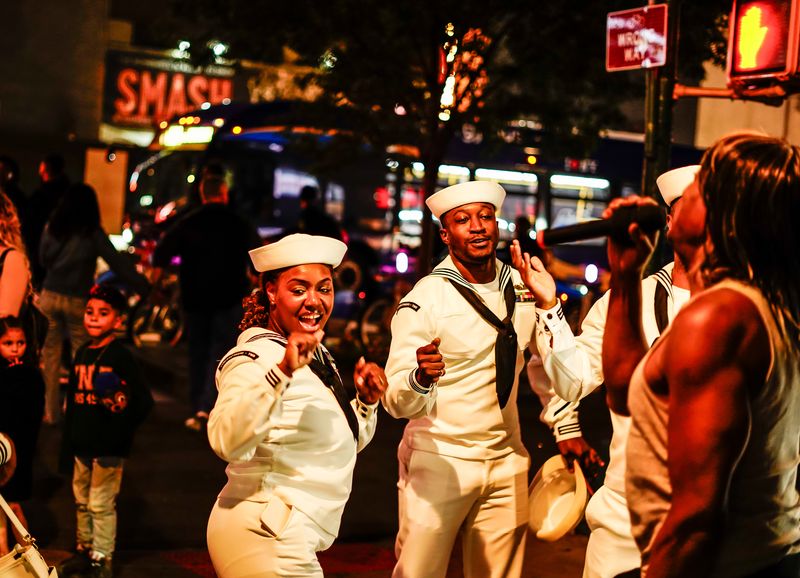
That is the same instinct I rely on for event work back home. A wedding reception, a block party, a concert crowd, the real moment usually happens off the shot list, and you only catch it if the camera is already up and ready rather than still in the bag.
Shooting a City After Dark
Night photography in a city like New York comes down to managing two things: light sources that are constantly changing and a shutter speed slow enough to gather what little light you have without turning every frame into blur. I shot most of the night handheld, leaning against railings and doorframes for stability rather than carrying a tripod through crowded sidewalks.
Blue hour, the twenty to thirty minutes after sunset before the sky goes fully black, is the most useful window of the whole night. The sky still holds color and gives you something other than pure black behind your subject, while building lights and streetlights are already bright enough to expose the foreground properly. Once true dark sets in, you lose that balance and have to lean harder on artificial light alone.
ISO is not something to fear at night. I pushed mine considerably higher than I would for a daylight portrait session, and the resulting grain in a few frames reads as texture rather than a flaw, especially in the black and white conversions. A slightly noisy image with real light and real composition beats a clean image shot too early, before the city actually turned on.
What Night Photography Teaches You
Almost everything I shoot for clients happens in daylight or with a flash I control. New York at night forced me to work entirely with light I had no say over: streetlights, building windows, headlights, whatever the city happened to be doing at that hour. That is a different discipline than lighting a portrait, and it sharpens your eye for available light fast, because you cannot fix a bad exposure by moving a light stand.
I came home reading ambient light more carefully on evening event work, watching for the same kind of found, unrepeatable moments that made the Fleet Week shot work. Every travel trip teaches a different lesson depending on what the location forces you to adapt to, the way a Chicago city trip taught me to read reflections and a desert trip in Arizona taught me to slow down for landscape light. New York's lesson was trusting whatever light the city gave me and making it work.
Frequently Asked Questions
Where is the best spot to photograph the Manhattan Bridge?
Washington Street in DUMBO, Brooklyn is the classic spot: the street frames the bridge dead-center with the Empire State Building visible through one of its arches, especially at dusk or after dark when the building lights come on. For a different angle, walk down to the waterfront under the bridge itself and shoot straight up into the steel trestle work for a more abstract, architectural composition.
What camera settings work for New York night photography?
A wide aperture around f/2.8, a shutter speed slow enough to gather light without introducing blur from hand shake, generally 1/60 or slower with stabilization or a tripod, and an ISO you raise as needed rather than fear. Blue hour, the twenty to thirty minutes after sunset before full dark, gives you the most usable light because the sky still holds color while building lights are already on.
Is DUMBO a good neighborhood for photography?
Yes. DUMBO has cobblestone streets, exposed brick warehouses, the Manhattan Bridge, the Brooklyn Bridge, and waterfront views of the Manhattan skyline all within a short walk. It is one of the most photographed neighborhoods in New York for exactly that reason, so expect company if you shoot the classic angles during golden hour or on a weekend.
How does travel photography help you grow as a photographer?
Travel photography forces you out of familiar locations and lighting conditions. You adapt to new environments quickly, find compositions in unfamiliar places, and work with whatever light and crowds you are given instead of a scouted, controlled setup. It builds versatility, expands your portfolio, and keeps your eye for composition sharp.
Book a Portrait or Event Session
I shoot portrait and event sessions in Charleston and the DMV, and I bring the same eye for available light to every city I travel to, day or night. Check out my portfolio to see the range of my work, or book a session.
If you are in the DC, Maryland, or Virginia area, visit my DMV portrait photographer page for packages and availability. Travel sessions are available by request for locations beyond Charleston and the DMV.